Safavid Tiles
Dominic Winter Auctioneers are pleased to announce their forthcoming Antiques sale on the 16th July 2026, which includes three lots of 17th century Safavid Tiles.
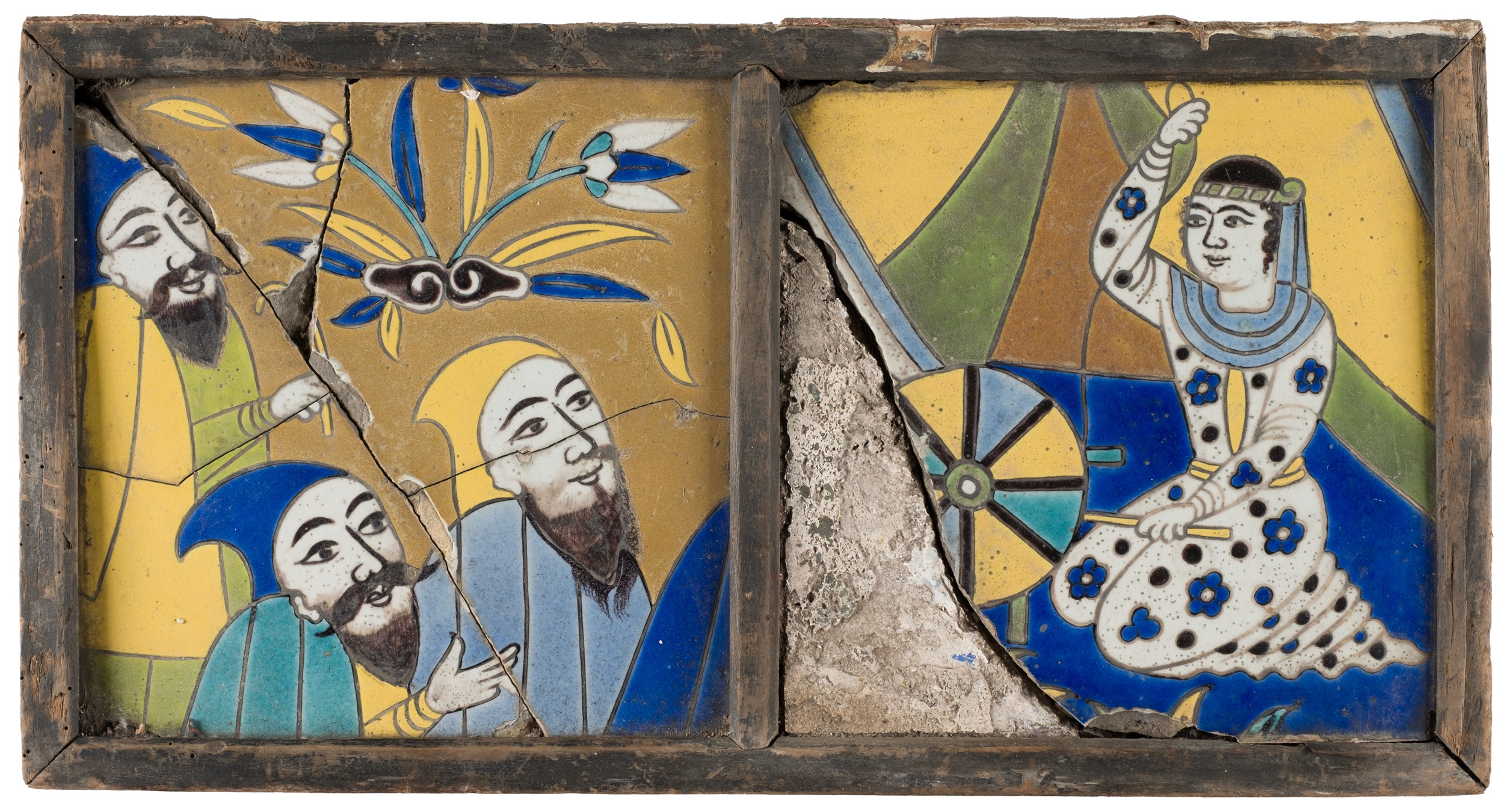
Lot 592 - Safavid Tiles. Two polychrome Safavid tiles, Iran, late 17th century
At least three of the four tiles offered in these three lots (592-594) would seem to originate from what is known as the Tile Arcade from Safavid Isfahan, a stunning architectural ceramic masterpiece from c. 1685-95. The 36 arch-spandrel panels were made using the cuerda seca (dry cord) technique. Many were salvaged during the late 19th-century urban demolition of Isfahan palaces, and subsequently dispersed in collections around the world, with new friezes and ‘orphans’ sometimes appearing for sale. A significant portion of the tiles were brought to the Royal Ontario Museum (see rom.on.ca), which conducted extensive research into the artists and architectural context behind the arches.
For the most comprehensive information on this project, see Lisa Golombek & Robert B. Mason, Princes, Dervishes and Dragons: The Tile Arcade from Safavid Isfahan (c. 1685–95), Edinburgh University Press, 2025.
The 36 friezes consist of tiles which are 24 cm square, arranged 16 across and 6 down each side, the authors assigning them within three themes: Secular (SEC), Literary (LIT) and Religious (REL), the latter being the most intriguing, because they uniquely broke from Islamic artistic norms to visualize holy figures and emotional events.
‘Each tile would have an identical counterpart mirrored on the other side of the arch, and also another arch with an identical design elsewhere in the palatial building they were originally made for. So that means there exist somewhere two versions of each tile, and two mirrored counterparts, all made from the same pattern or stencil’, (rom.on.ca: Safavid Tile Project II: Rebuilding the Friezes).
The figures in the left tile offered here bear a striking similarity with the three figures depicted in the top left corner tile of a panel that represents Armenian clerics and a Muslim/Shah celebrating an occasion, possibly the founding of a church. Originating from Isfahan in the second half of the seventeenth century, the panel is held by the Louvre-Lens Museum, AD5118. In the Louvre-Lens tile the three figures carry crosses and a banner and are shown on a blue ground; in the tile offered here the figures are on an ochre ground with a floral spray in the background. See Princes, Dervishes and Dragons, pp. 128-9 & figure 5.11.
The peasant woman spinning in a camp that is depicted in the right tile offered here is similar to one that forms part of a frieze held by the Museum für Islamische Kunst – Staatliche Museen zu Berlin, Museum for Islamic Art, I.3925. See Princes, Dervishes and Dragons, pp. 71-2 & figure 4.6. That tile is placed as 2A-L in the reconstruction of the ‘Literary’ frieze that forms Template 8.LIT12 Bahrum Gur and the Unfaithful Dog frieze, see pp. 307-08 and illustration on p. 205. A second tile, using the same stencil, with the figure reversed (as here) is pictured as an ‘orphan’ outside the reconstruction. There are differences between the colour blocks in the two tiles depicted in the book, and the tile offered here. Most significantly the dresses on the tiles in the book are light blue and yellow respectively, neither having a pattern. The tile offered here features a white dress with a blue and black floral pattern.
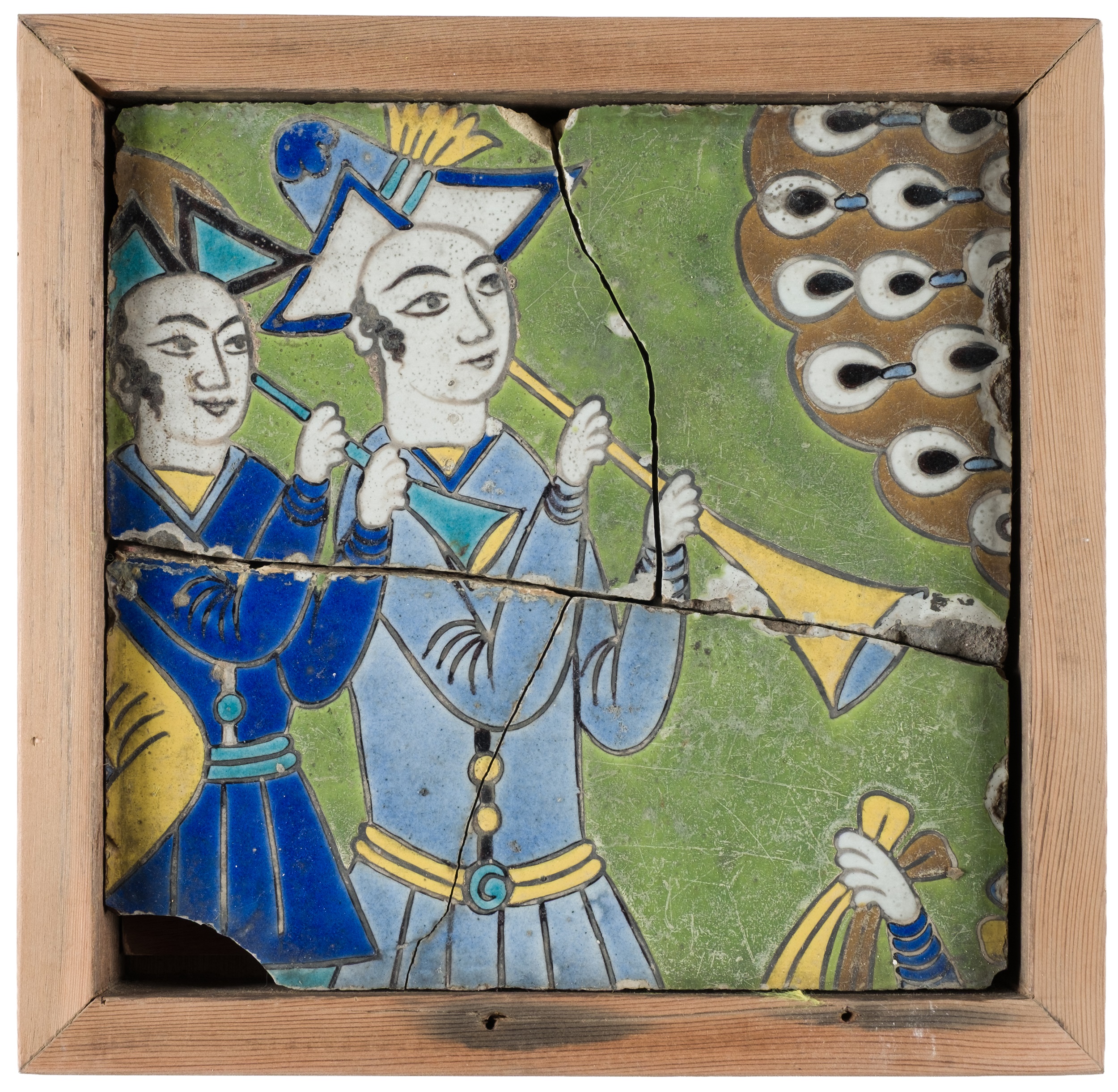
Lot 593 - Safavid Tile. A polychrome Safavid tile, Iran, late 17th century
This tile pictorially nearly aligns to be the missing Tile 1E-R in the ‘Religious’ Frieze reconstruction that forms Template 8.REL01 Women Dancing at a Sacred Tree frieze, see Dervishes and Dragons, pp. 318-20, illustrations on front cover and p. 208. The front cover illustration shows a spandrel missing the top row of these tiles: ‘The Museum of Islamic art, Doha, purchased the right spandrel of this tile arch (minus the top row) from the sale of the Sehmer collection in 2004 (P.O.321.2004) [Christie’s, London, 27 April 2004, lot 285]. It is not known when Sehmer purchased the spandrel, but it is likely to have come from Kevorkian's collection, certainly before 1978 when Luschey-Schmeisser referenced it in her publication. Doha also purchased two tiles from the blue frieze. Christie's sold two conjoined tiles of the dancers on the blue ground in 2014 (2B-R and 3B-R (Figure 8.REL01.2)). A pair of tiles with a musicians on the blue ground is in the Hetjens Museum, Dusseldorf (1984 101 a-d; tiles 1A–R and 2A–R). The green ground tile with two men standing to the left of the tree, not holding instruments but gesturing, perhaps singing, is in the Yamamoto Collection, Tokoname, Japan (1F–L). The tile with a tree (1C–L) was in the collection of Simon Ray. We have reversed it in the template. The history of the other single tiles is untraceable’, Princes, Dervishes and Dragons, p. 320.
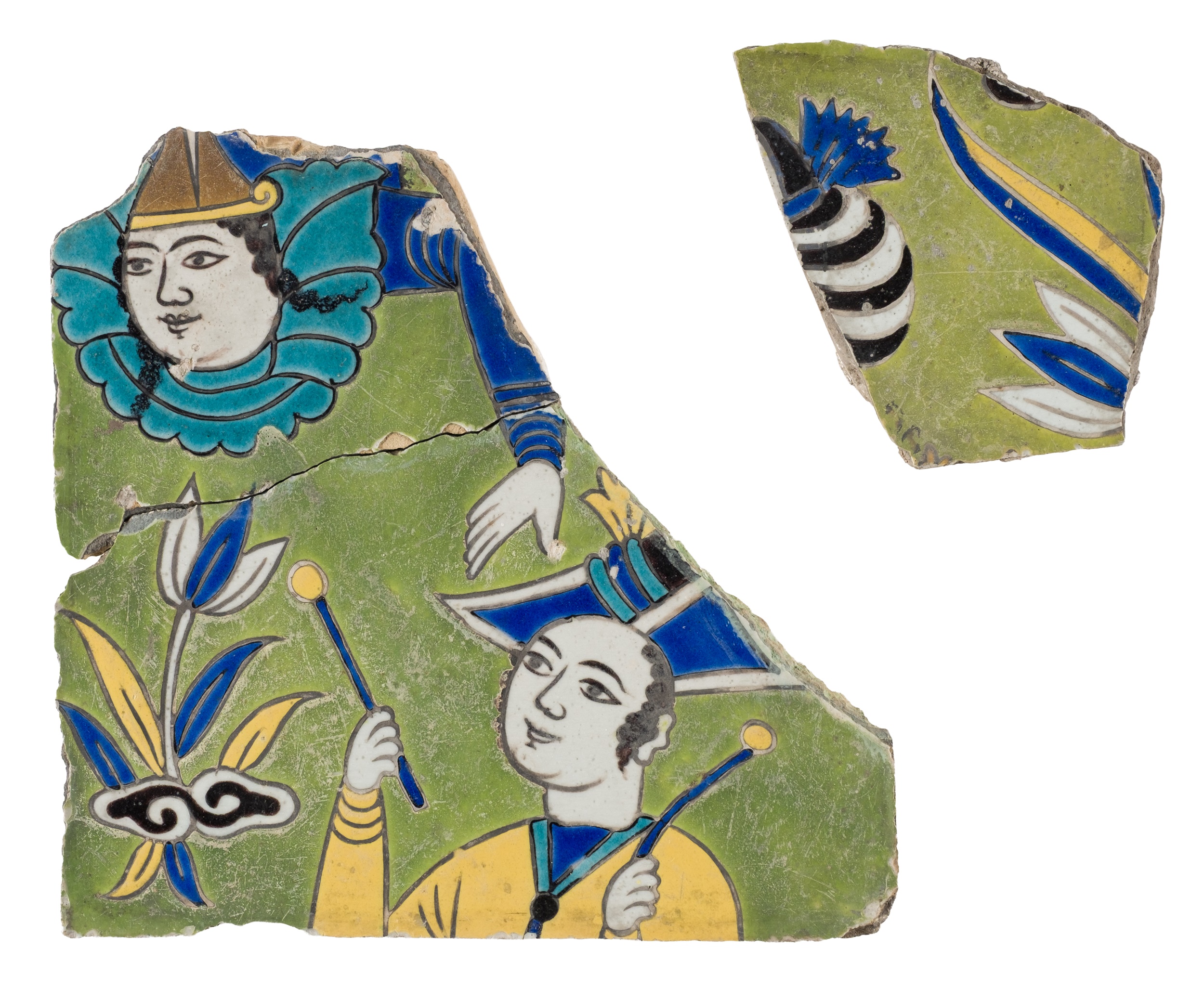
Lot 594 - Safavid Tile. A polychrome Safavid tile, Iran, late 17th century
This tile is the ‘twin’ of Tile 4A-R in the ‘Religious’ Frieze reconstruction that forms Template 8.REL01 Women Dancing at a Sacred Tree frieze, see Princes, Dervishes and Dragons, pp. 318-20, illustrations on front cover and p. 208.
The fragment with the striped turban and floral spray may relate to one of the ‘Secular’ Friezes, e.g. 8.SEC01 or 8.SE04, see illustrations Princes, Dervishes and Dragons, pp. 179 & 181.
For all pre-sale enquiries please contact the auction offices at:
info@dominicwinter.co.uk
For more information and to view the full auction catalogue, please visit: https://www.dominicwinter.co.uk/auction-calendar/
Upcoming Auctions
Old Master Prints & Drawings, British & European Paintings, Drawings & Prints
To see a page-turning version of our catalogue, please see the Virtual Catalogue.
Live bidding is available on our website on sale day, a BID LIVE button will appear 60 minutes before the sale starts. Please register at least 24 hours before the sale starts. Commission bids can be left on our website up to 1 hour before the sale commences. For telephone bids, please call the office on 01285 860006.